Engineering,Supply,Manufacture,Construction
Vibro Stone Column
geotech’s method of constructing stone columns through fill material and weak soils, to improve their load bearing and settlement characteristics, provides an economic and technically sound solution to a wide range of geotechnical and foundation problems.geotech’s method of constructing stone columns through fill material and weak soils, to improve their load bearing and settlement characteristics, provides an economic and technically sound solution to a wide range of geotechnical and foundation problems.
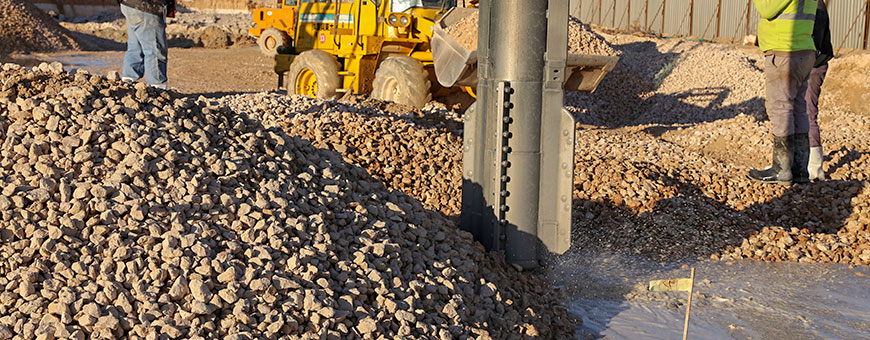
To construct the stone columns, the vibrator is allowed to penetrate to the design depth and the resulting cavity is filled with hard inert stone, free of clay and silt fines. The required interaction between the stone columns and the surrounding soils, is developed by the stone infill being introduced and compacted in stages, each charge of stone being thoroughly compacted.
The stone columns and the confining soils form an integrated foundation support system having low compressibility and improved load bearing capacity. In cohesive soils, relatively rapid consolidation is achieved through excess pore water pressures being readily dissipated by the stone columns.
The stone column layout can be arranged to suit varying combinations of load, soil type and required settlement performance. In general, column spacings are in the range of 1.2 to 2.0 meters beneath main load bearing foundations, and up to 3.0 meters beneath floor slabs.
THERE ARE TWO PRINCIPAL METHODS FOR CONSTRUCTING VIBRO REPLACEMENT STONE COLUMNS :
1. The conventional Top Feed process
- This is where the hole formed by a purpose-built base machine with a vibrator mounted on the mast of a purpose-built excavator. After removing the vibrator, the hole remains open and the stone infill is added and compacted by the vibrator in stages, assisted by compressed air.
2. The Bottom Feed process
- This is a 'dry' process used to treat unstable soils and/or soils with a high ground water level.
Firstly, the Vibrator penetrates weak soils under action of vibrations and 'compressed air' jetting medium and forms a hole to design, usually a competent bearing stratum. After being held at depth for a short time, the vibrator is withdrawn and a charge of stone is placed into the hole.
The vibrator is reintroduced into the hole, the stone is compacted, forced out and tightly interlocked with the surrounding ground. By adding successive charges of stone and compacting each one, a column of very compact stone is built up to ground level. The reinforcing and compacting action of the stone columns serves to significantly improve the load bearing and settlement characteristics of the ground.
Related Applications
Geotechnical Solutions