Engineering,Supply,Manufacture,Construction
Wick Drains
Wick drains (also referred to as Prefabricated Vertical Drains or PVD), are used in soft, compressible soil to allow drainage tracks for pore water.
Cohesive soils (clayey soils) are generally characterized by having a low permeability. Consolidation of a soil relies on the ability to evacuate water out of the soil matrix. By installing a network of drains and the placement of preloading or surcharge program of the site, induces or forces settlement within a limited period of time. This allows the control of residual settlements during the life time of the structure to within acceptable limits.
How your project can
benefit ?
As a simple, modular system using carefully integrated components, Tensar reinforced soil structures offer a number of advantages over traditional reinforced concrete:
- Accelerate drainage during surcharge programs
- Consolidate tailing ponds and leach pads
Technical Details
Wick drains consist of a geotextile filter wrapped plastic strip with molded channels that allow water to travel to the ground surface. Wick drains are typically installed prior to placement of a temporary fill load to accelerate the consolidation of compressible soils.
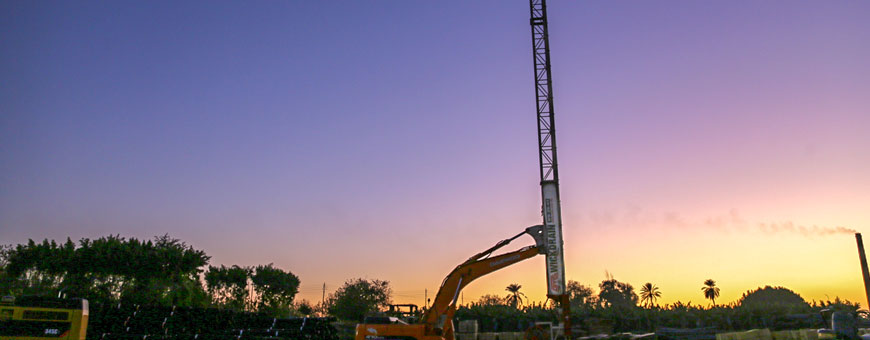
During installation, a hollow mandrel that is mounted on an excavator or crane mast has a drain fed down it. At the bottom, an expendable anchor plate is used to connect the wicks. Then the mandrel is inserted to the designed depth using a vibratory hammer. The wick drain is left in place when the mandrel is removed from the ground. At the ground surface, the wick drain is cut and connected to a new anchor plate. This process is repeated in many locations over the construction site.
Advantages of PVDs over sand drains
- The installation rate of PVDs is typically 5,000 linear meters per day, which results in a significantly lower project cost.
- There is no risk of PVDs breaking installation, while sand drains may have discontinuities if the mandrill is withdrawn too fast.
- There is no risk of shear failure of PVDs during settlement, while sand drains are vulnerable to shear failure during settlement.
- PVDs are factory produced materials and are quality controlled, whereas sand drains are subject to the quality variance of naturally occurring sands.
Related Applications
Geotechnical Solutions